Sunday, October 17, 2010

Venison shank with barley & mushroom risotto


This sounds a bit restaurantish but is in fact very easy although it does take a long time. I went to the farmers' market and was actually planning to make myself some hare or rabbit or pigeon, but I'd forgotten that the game dealer is only there every second week and that the only game available would be venison. Because I was cooking for myself I was on a budget, so venison shank was the most economical option. I read a few recipes for venison and decided to wing it. I couldn't decide what to make with it but I gather that barley is now becoming a bit of a restaurant cliché as an accompaniment; I hardly ever eat in restaurants so had never had it before. For the barley, I adapted a recipe in Nick Nairn's book New Scottish Cookery. So this is a Scottish-Italian fusion which is all about autumn - Scottish ingredients, red wine, slow cooking, mushrooms, that kind of thing. Yes, it contains wine twice. No, I don't think that's a bad thing.

Ingredients for the venison:

1 venison shank per person

3 onions, roughly chopped

1 carrot, peeled, halved and sliced lengthwise

1 stick of celery, roughly chopped

a handful of diced pancetta

three garlic cloves, crushed

the leaves from 4-5 sprigs of thyme

1 bay leaf

1/3 bottle of red wine

olive oil

sea salt and freshly ground black pepper

300ml dark meat stock

1 piece of very dark (75%) chocolate

enough watercress for as many people as are eating

Ingredients for the barley risotto (assuming 4 people):

175g pearl barley

250g chestnut or wild mushrooms, cleaned and sliced into .5cm slices - it should be wild mushrooms but I couldn't afford them, so used chestnut with some soaked porcini thrown in

1 glass of red wine

1 onion, finely chopped

1 garlic clove, finely chopped

300ml meat or vegetable stock

olive oil

butter

chopped flat leaf parsley

1. Preheat the oven to 160C.

2. Heat a thick-based casserole pan and brown the venison shanks one by one until they're all nicely brown.

3. Remove the shanks to a plate and add the pancetta to the pan. Cook it until it's going golden, then throw in the onion, carrot, celery and garlic and cook it until softened.

4. Add the wine and chocolate and let it reduce, scraping up any brown residue. When the wine has reduced by half, add the meat and herbs and stock, season lightly with salt, cover and put the casserole in the oven for at least 2.5-3 hours, until the meat is tender.

5. Meanwhile, closer to the time of eating, heat a heavy sauté pan and add a glug of olive oil. When the oil is hot, add the pearl barley and cook it for five minutes until it's starting to go golden brown - don't let it burn, though. After five minutes, add the onion and garlic and let it soften, stirring it in. If it looks like the barley is getting too brown, add the wine and let it reduce a bit.

6. If the onion has softened and the barley hasn't gone too brown, add the wine and stock and let it simmer.

7. Meanwhile, sauté the onion in butter in a separate frying pan, until it's nicely browned. If you were soaking porcini in hot water, add the water to the barley and the porcini to the mushrooms, being careful not to let the residue at the bottom of the water get out. (It's mostly dirt.)

8. Now, it's pretty much up to you. You need to keep simmering the barley until the stock/wine mixture has reduced and been absorbed, while the barley softens. This can take 30 minutes or more. When the mushrooms are done, remove them to a bowl.

9. When the barley is nearly done, check the venison - it should be falling off the bone by now and very tender. Remove it and the bone to a separate plate. The venison shank contains marrow, which you can eat if you want. Compared to beef or veal marrow it's relatively tasteless but it can add a richness to the final sauce, so by all means scrape it out and save it if you like that kind of thing.

10. Now, the liquid your venison cooked in should be purple in colour and full of bits of cooked bacon and onion and carrot and so on. You don't want to eat any of that. You could, but it'll be boring. Sieve it. Get a sieve, place it over a large bowl and pour the liquid into the sieve. Next, use a wooden spoon to squeeze all the remaining juice out of the sodden vegetable mush in the sieve. You'll be surprised how much flavour you can squeeze out.

11. Return the strained liquid to the venison pan and put it on the heat. If you are using the venison marrow, add it. You want to bring this liquid to the boil and simmer it until it's reduced and tastes more intense. This can take a while, so keep an eye on your risotto and make sure that the barley is becoming tender and the liquid is being absorbed. You can add the mushrooms to the barley at this stage and stir them well in.

12. When your venison liquid is reduced to being an intensely flavoured syrupy sauce, check it for seasoning and season if necessary - it'll probably need at least some black pepper - then return the meat to it to heat up.

13. When your barley risotto is tender and aromatic, take it off the heat and add a sprinkling of parsley, then toss the watercress into the venison pan and let it wilt before giving everyone a good ladle or two of barley, then a bed of wilted watercress followed by the meat from a shank and plenty of the jus to tie it all together.

Chocolate may seem weird, but venison and chocolate get on strangely well with each other and the final thing doesn't taste chocolatey, just slightly smokey and mysterious. Needless to say, if you don't have posh 75% dark chocolate, this isn't going to work; a Galaxy is not the right thing here.

Sunday, October 3, 2010

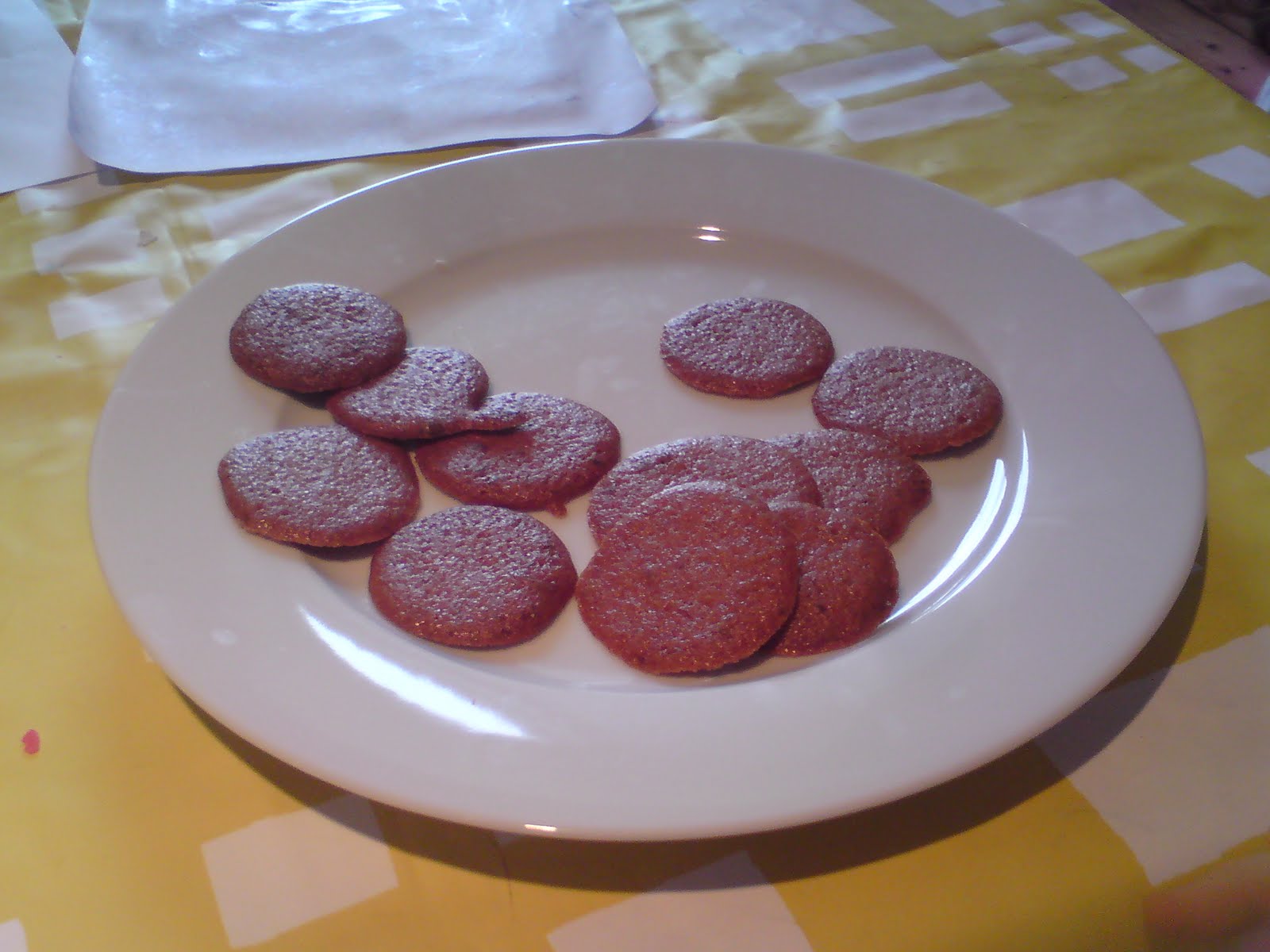
Little Cinnamon Biscuits Like They Serve In Posh Cafés


Today, the Tortemeisterin had a yearning to bake something. Anything. So had I, which was weird because I never normally bake things. I for my part wanted to make bagels, which I'd never made before, but I thought the ability to whip up a few bagels would be a useful skill. The Tortemeisterin wanted to make little crunchy cinnamon-flavoured biscuits like the kind they serve with your coffee in Greek cafés (and in posh cafés elsewhere in the world). I happily yielded the kitchen to her, on the grounds that the little cinnamon biscuits sounded like they would take less time; you don't have to let the dough rise, basically. I ended up hovering over her shoulder and doing odd jobs like melting the butter and golden syrup together, while she handled everything else. So this one was a true joint effort.

A recipe was located on the Channel 4 website, and I reproduce it here with our annotations.

Ingredients

* 50g butter
* 125g golden syrup (we were a bit short and used more like 110g)
* 1 egg yolk, beaten
* 125g plain flour
* 50g soft dark brown sugar (we used Muscovado)
* 1 tsp ground cinnamon
* 1/2 tsp baking powder

"1. Preheat the oven to 180°C/ fan160°C/gas 4. Line a baking tray with baking paper."

Note: you don't have to line a baking tray with baking paper. We did that for the first batch, and the biscuits stuck to the paper. You might be better off lightly greasing a non-stick baking tray and letting the biscuits get firm before you try and remove them - a sharp tap with a knife should knock them off in one go, but be careful not to scratch the non-stick.

"Melt the butter and golden syrup in a large saucepan over a gentle heat until they come together. Remove from the heat and stir in the egg yolk."

Note: make sure that you don't heat the butter so much that it foams. You just want it to melt. If you start cooking that butter, the egg yolk will scramble when you pour it in the pan.

"2. Sift the remaining ingredients together into the saucepan and fold into the egg and syrup mix. You should now have a cinnamony paste. Spoon 1/2 teaspoon-size dots onto the lined tray. Keep well apart, as they’ll spread a bit. Bake for 15 minutes, then cool before removing. They will crisp up a little more as they cool."

Note: an extra three or four minutes won't hurt. We got about 40 biscuits out of this mixture. Don't be tempted to put large blobs on the baking tray; the biscuits are very sweet and very intense. A half a teaspoon of mixture will give you a biscuit large enough to accompany a single espresso.

Store them in tupperware and bring them out next time you make a cup of real coffee. They're so crunchy they're almost like some kind of cinnamon-flavoured sweet. Respect to Channel 4 for the recipe and my lovely wife for deciding to make it in the first place.

Thursday, September 30, 2010

Herb-rubbed slow-cooked roast pork


When it's your birthday, it's sometimes a good idea to announce that you're gonna cook the birthday dinner yourself. This is especially true when you don't trust anybody else to cook something that you aren't going to find objectionable one way or the other. If you let someone else cook the dinner, you open yourself up to multiple disappointments. The chief one is "I know that you like X and specifically asked to have X for your birthday dinner, and indeed begged me to make X, but I thought just for a change you might like Y, which I have never cooked before but thought in my very deluded mind that you might enjoy, even though it is not what you explicitly requested, and even though I sort of fucked it up. But I am your friend/relative/parent, and I hoped you wouldn't mind."

No, it's better to do it yourself. Which is how I came to be cooking roast belly of pork, potatoes and cabbage on the afternoon of my birthday, because literally nobody else I know cooks belly pork. I love belly pork, partly because it it's a very forgiving cut of pig, not to mention a cheap one (it's nearly impossible to overcook, whereas a regular pork chop is easy to turn into a rubbery puck of sadness) but mostly because it fulfils the dream of roast pork - something that's succulent and delicate at the same time. Why potatoes? Because if the theme is roast pork, you just need roast potatoes, unless you're going Chinese, which I wasn't. Why cabbage? Because the lusciousness of roast pork belly needs a fairly austere green vegetable to balance it and cabbage is about as austere as it gets.

So I bought two lovely pieces of pork belly from Austen Davies' stall at the farmers' market. I had to feed six adults plus one child: my mum, my mum's sister, my mother-in-law, my father-in-law, my lovely wife plus myself, plus of course the kid. Each of the pieces of pork were too small to feed all those people, but both together didn't fit in my roasting tin. Solution? To cut the smaller one down its length and stick it in the pan next to the other one. A side-effect of this would be that there would be more lovely crusty outside to the pork than there would normally have been.

Roast pork, roast potatoes and cabbage

1 piece of pork belly with skin, preferably on the bone, the thicker the better, c. 1.5-2kg

roasting potatoes (I used Desirees and will admit to missing Ireland, where it's much easier to get Roosters)

1 large white cabbage

bay leaves

juniper berries

caraway seeds

sea salt

black peppercorns

olive oil

butter

a glass of white wine

vegetable stock made with Marigold stock powder

1. Preheat the oven to 220C (200C if you have a fan oven.) Crush a generous pinch of sea salt, a good few black peppercorns, two or three dried bay leaves and about four juniper berries together in your mortar and pestle. Keep pounding till it's a medium-coarse powder. You don't want bits of bay leaf and chunks of berry turning up on your fork. You want to rub this on the outside of the meat to make a delicious crust, so keep pounding away until a perfect stranger who doesn't know what's in the mortar couldn't tell what it is from a casual glance. So, not dust, just a coarse powder.

2. Okay. This is roast pork. You want crackling, right? Crackling is fun. Let's assume that you forgot to ask the butcher to cut off but keep the skin for you, so the skin is still attached. We will now cut through the whole crackling problem with a very sharp knife. You will need to be careful, you will need to be patient and you will need to not cut your hand off.

The skin on the roast pork will probably be more loose at one end than at the other. Go for the loose end. Lift the skin up and slide the blade of a very sharp knife underneath, and then work the blade under the skin, cutting away the connective tissue and pulling the skin gently but firmly upwards as you go, so that you cut the skin off in one piece.

3. Rub the meat all over with the salt/pepper/herb mix, and when it's been rubbed in, place the meat in a roasting tin and place the loose skin on top of it, skin-side-up. If you have any excess rub, it would be a good idea to rub some onto the skin at this point. If you don't, just rub a little salt into it - and I mean a little, preferably Maldon sea salt or your preferred good sea salt, crushed. It'll help give flavour to the crackling.


4. Now, leave the meat to sit for a good half an hour while you get the veg ready.

5. Half-fill a large saucepan with water and salt it lightly. Peel as many spuds as you want (I usually estimate about two per person - like most things, they shrink in the cooking), cut each medium-sized one into two pieces and each large one into at least three. Roast potatoes do not like to be perfectly smooth spheroids. Edges and corners helps them become crispy. Do not hesitate to hack off the end of a potato if it has dodgy-looking bits in it. Rinse the spuds before you put them in the water - it washes off the starch, which you don't want. Place spuds in cold water. Turn the water on for the spuds and cover the pan.

7. Your pork has now been sitting in the kitchen for about half an hour, and because you salted the skin, the skin is probably starting to exude a little moisture. Dab this off with a bit of kitchen towel, as crackling is less likely to happen when the skin is damp. Stick the pork in the oven. This is the bit where I usually lean down and watch through the door as it starts to sweat. I don't know why I do that.

8. You are now cooking your spuds in water. What the hey, some of you ask, aren't we making roast potatoes? Nigella Lawson, who I respect greatly, has a very good rule for roast potatoes: you need to cook them for longer than you think, at a hotter temperature than you think. Therefore, you need to start cooking them at the same time as, if not before, the meat. To get them crispy, they need to be fluffy when they hit the pan of hot fat or oil in the oven. To get them fluffy, you have to parboil them first. Let them come to the boil and take the lid off when the water boils, otherwise it'll boil over. Let them cook until they are tender enough that you can fairly easily stick a fork into them. (Don't try to test them by sticking a sharp knife into them. You can stick a sharp knife fairly easily into anything, so it will give you a false positive for tenderness. A fork is more reliable.)

9. Pour some olive oil, or your preferred fat (please, not butter or margarine - the former will burn and the latter is bad for you) into the bottom of a baking dish and stick it in the oven. You need to let this get hot before putting the parboiled potatoes in it, and that will take a good ten minutes. After your pork has been cooking for about 25 minutes, turn the oven heat down to about 150C. This will sort-of slow-cook the pork (it's actually too hot for real slow cooking, but it gives you time to do other things).

10. When your potatoes are tender drain them, leave them for a couple of minutes to dry off a bit, and then give them a quick glug of olive oil and transfer them to the baking dish to roast.

11. Congratulations. Most of the work is done. Sit down. Have a glass of wine. You can leave your pork and potatoes in the oven for a good hour and a half while you read a book, get ready for the party, chat to your guests about reality TV or Richard Dawkins or whatever floats your boat. Apart from the next bit.

12. Forty minutes before showtime, wash the cabbage, chop it into shreds and wash the saucepan that you cooked the spuds in, if you haven't already. As soon as it's clean, you will recycle this saucepan to cook the cabbage in. See how I save you washing up? When it's clean, half-fill it with water, put the water on to boil and cover it.

13. Twenty minutes before showtime, take the pork out of the oven and let it rest. The next bit is crucial: right after you've taken the pork out, whack the heat up in the oven to about 220C, take the skin off the pork (it'll probably look like it's almost but not quite crackling) and lay it on top of the spuds.

14. Next, blanch the cabbage in the boiling water for just a few minutes. There are two ways to cook cabbage; one way is to do it for about three hours, the other way is to do it for about five minutes. Every other way leads to nasty cabbage.

15. When the cabbage is blanched (like, two minutes in boiling water), take it out and cool it down in cold water. Rinse the saucepan. When you're ready to serve up, heat some butter in the saucepan, plus a few crushed caraway seeds. Finish off the cabbage by sautéing it lightly in the butter. Squeeze a little lemon juice over the top if you're feeling frisky.

16. Deglaze the sticky brown goo in the roasting tin with the white wine and veg stock that you made at some point, scraping up the goo with a wooden spoon so that it dissolves into the liquid. Let this boil so that it becomes a piquant jus for your pork. Your crackling should have puffed up nicely in the twenty minutes that it was away from the pork, sitting on top of the potatoes. If not - call me and we'll discuss it.

17. Cut the pork into thick slices and serve with a good piece of crackling, a few roast potatoes, a helping of cabbage and some jus from the pan. As you can see from the picture at the top, the potatoes weren't as crispy and golden as they might have been. But the pork made up for it. Oh yeah.

This particular meal was helped enormously by the fact that the meat was really, really good - flavourful and incredibly cheap. Two large slabs of it cost me £8 each. I dunno how they make a profit on that but I am very smug that half of one of those pieces is still nestling raw in my freezer, waiting for me to do things to it.

You wouldn't want to eat this every day. But for a birthday, it works.

Sunday, September 19, 2010

Potato dauphinoise


I think my posts are becoming too long, so I've put the recipe at the top for a change.

The potato can be lots of things: comforting (baked), succulent (roasted), sociable (chips). But there's only one way with potatoes that's actually sexy, and it's potato dauphinoise: slices of potato cooked in a garlicky cream and then baked in the oven with a light cheese topping. Meltingly soft, it should have a cheesy-garlic twang and the sauce should flow into the embrace of whatever gravy or jus you've managed to coax out of whatever else that you've cooked (in last night's case, a very small shoulder of lamb that I'd marinaded in thyme, garlic and olive oil and which had unfortunately been completely eaten by the time I took the photo.)

This is my recipe, anyway. You'll need:

1 medium-sized baking potato per person;

n + ((n/2)-1) crushed (but not mashed) garlic cloves per person, to a maximum of n=8, where n is the number of people you're making it for - so if it's just yourself, use 1 garlic clove, but if there are two of you use two, and if there are three of you use 3.5, and if there are four of you use five, and so on, but I wouldn't ever use more than eight cloves;

c. 300ml of double cream - you will need more if cooking for more than two people;

a sprig of thyme;

a bay leaf;

a handful of grated mature cheese - Gruyere is traditional but I used a mixture of Red Leicester and Parmesan last night, thereby making this Potato Dolphin.

1. Preheat the oven to 180C. Peel the potatoes and slice them thinly. The traditional thing is to slice them about a 1/4-inch thick, but last night I used my beloved mandoline slicer and got wafer-thin slices to see what would happen.

2. Place the potatoes, cream, garlic and herbs in a saucepan, season with sea salt and freshly ground black pepper and heat the cream until boiling. Turn down the heat and simmer for ten minutes.

3. While the potatoes are cooking, rub the interior of a baking dish with half a cut garlic clove and then smear it with butter.

4. When the potato has been simmering for ten minutes, fish out the garlic and herbs and throw them away. You don't want to be eating big chunks of garlic and sprigs of thyme. Next, pour the potatoes and cream from the saucepan into the baking dish, grate the cheese over the top (or scatter it over the top if you already grated it) and bake for forty minutes.

5. When it's tender and the cheese has formed a nice brown crust on the top, take it out and let it sit for ten minutes. This is essential! Why? Because otherwise it will be a.) volcanically hot and b.) too runny. You want it to congeal slightly and settle down before serving it. Or rather trying to serve it, because it will ooze.

6. Cut in portions like a creamy potato-based lasagna and serve with grilled or roast lamb - or steak, if you're really not worried about your arteries. This dish is crying out for browned, rare meat and winey juices.

This was my most successful dauphinoise ever. Not because of my years of experience and innate genius, but because the potatoes were sliced so thin. Sometimes my dauphinoises are heavy and starchy, but in this one the potato was almost but not quite melting into the sauce. Big thanks to my friend Niall Markey, chef-turned-farmer, who gave me the mandoline in the first place in an act of unprompted generosity. (Niall also makes the best pizzas I have ever eaten.)

I am not a huge fan of potato. I was brought up on boiled potatoes as a kid and if there's one process a potato shouldn't have to undergo, it's being peeled and boiled in water, and then served up just as it is, as if it were fit to eat. I don't like mash. I can more or less do without chips, unless I'm having either steak & frites or moules & frites. Apart from dauphinoise, which is a rare and guilty pleasure, I only love potatoes two ways: roasted and fried. The point of a potato, for me, is not the boring fluffy white stuff but the crisp golden crust surrounding the fluffy white stuff. There's a fair amount of work entailed in getting a potato to that state (peeling, pre-boiling, draining, cooking in hot fat) and so I can seldom be bothered to, thankfully for my cholesterol levels.

The single worst thing I have ever been served in a restaurant was a 'baked potato' in a place in Ballinasloe, undoubtedly one of the worst towns in Ireland (although it did have a surprisingly brilliant secondhand bookshop in which I scored an ultra-rare copy of Richard Farina's uncollected writings for 35p); when the baked potato finally appeared, it turned out that they'd peeled it, wrapped it in foil and heated it in the oven. That was the sum total of what they did to it. Because of course, there's a whole bunch of classic French recipes for potatoes that seldom if ever get tried, such as pommes fondant (olive-shaped bits of potatoes fried lightly then cooked in stock until the stock boils away and glazes the spud), potato croquettes (potato puree enriched with egg, formed into clumps, rolled in egg and breadcrumbs and deep-fried - hell yeah, I'm doing that one of these days), potatoes boulangéres, which my dad used to make: slice potatoes and onions thinly, alternate layers of them in a well-buttered baking dish, cover with stock and bake until they can be cut with a spoon. (The best way to do them is to place your meat on top, so that the meat juices run into the potato-onion mixture. My dad used to use chicken portions but lamb is also good.)

I hardly ever eat potato dauphinoise. I think the first time I ever ate it was in Pierre Levicky's much missed bargain bistro Chez Jules, in Dublin in the mid-90s. It used to be possible to go to Chez Jules and order a steak, potato dauphinoise and a bottle of wine on a student's budget. I think he did it by having very few things on the menu and using cheaper and more interesting cuts of steak than the usual sirloin and fillet, because Chez Jules was almost certainly the first place I ever tasted ribeye. The kitchen was semi-open and there was a constant sense of things exploding into huge bursts of flame as the chefs tossed glugs of wine into hot sauté pans. I had many memorable meals there, or maybe it was just a very few extremely memorable ones. The Chez Jules project died in Dublin because the Irish went straight from not having much of a taste for food to having a need to be seen to be spending a lot of money on it, and so a great but inexpensive idea like Levicky's became a place that Dubliners thought was beneath them, and we ended up with shitty rip-off joints like Cafe Soho (formerly the utterly contemptible Cornerhouse, if I remember its accursed name correctly). Levicky is back now, at least in my new town, and he has the same menu as before. Good man.